The Situation
What the current site tells customers
Every measurement below was taken directly from the live site in July 2026. None of this is cosmetic nitpicking — each one either turns customers away, hides the company from Google, or shows a site that has gone years without maintenance.
The footer says “©2026” because the year updates automatically — but a visitor on a phone sees a page that scrolls sideways, cuts the headline off mid-word, and promotes an event from seven years ago. For a company that sells reliability, the website is making the opposite argument.
Before & After
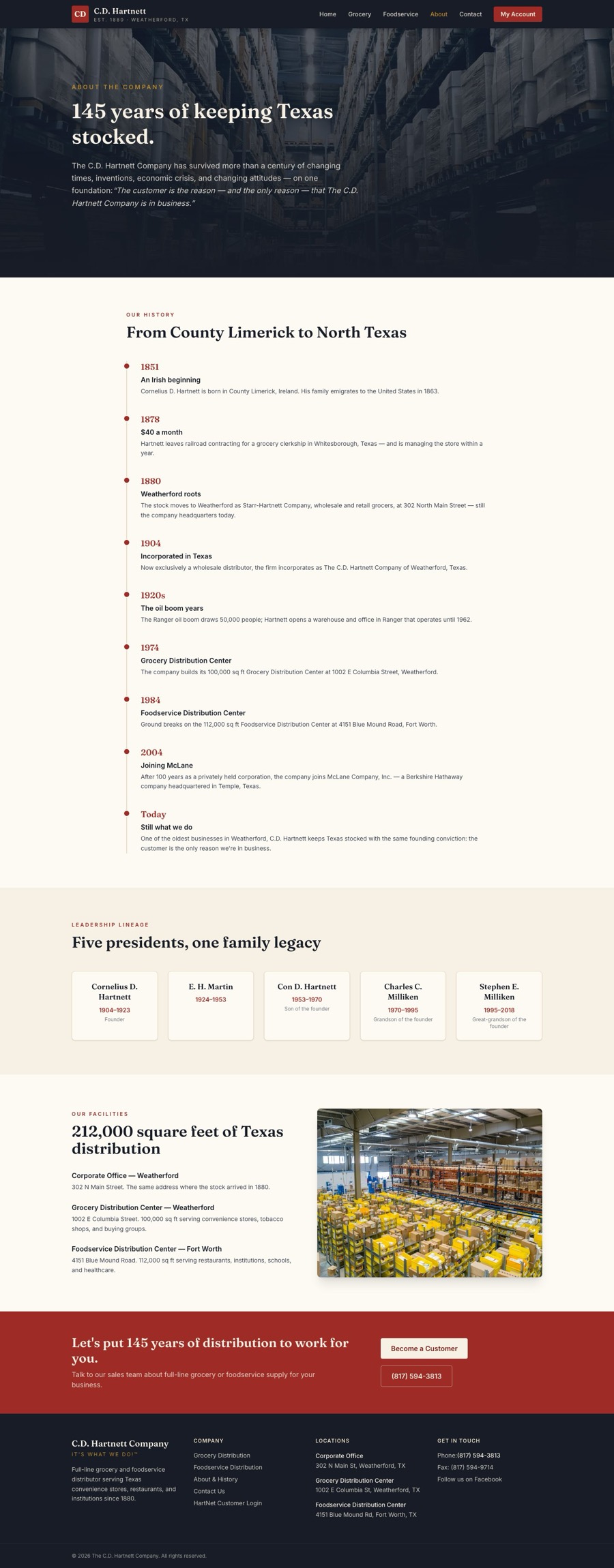
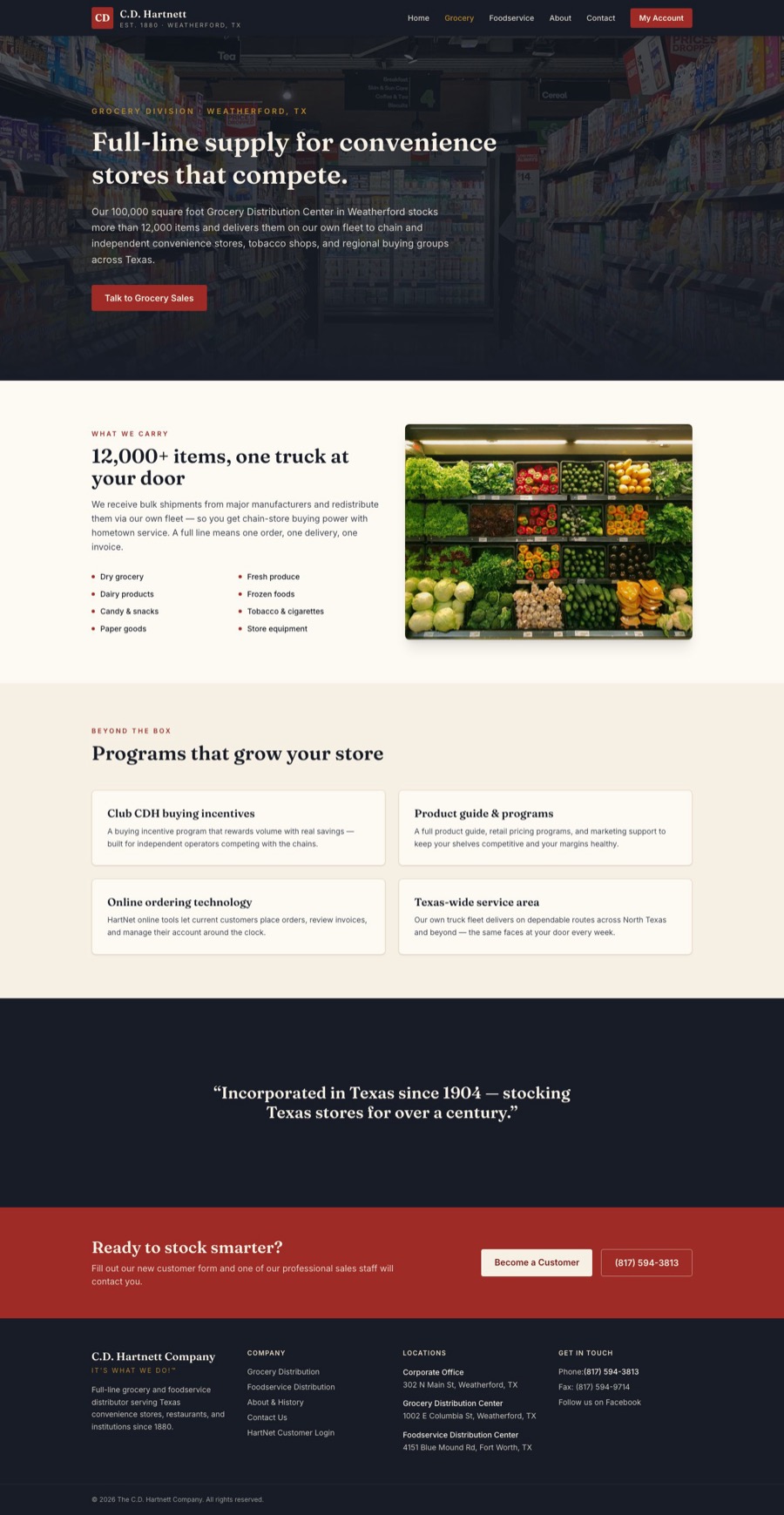
The same company, presented like it matters
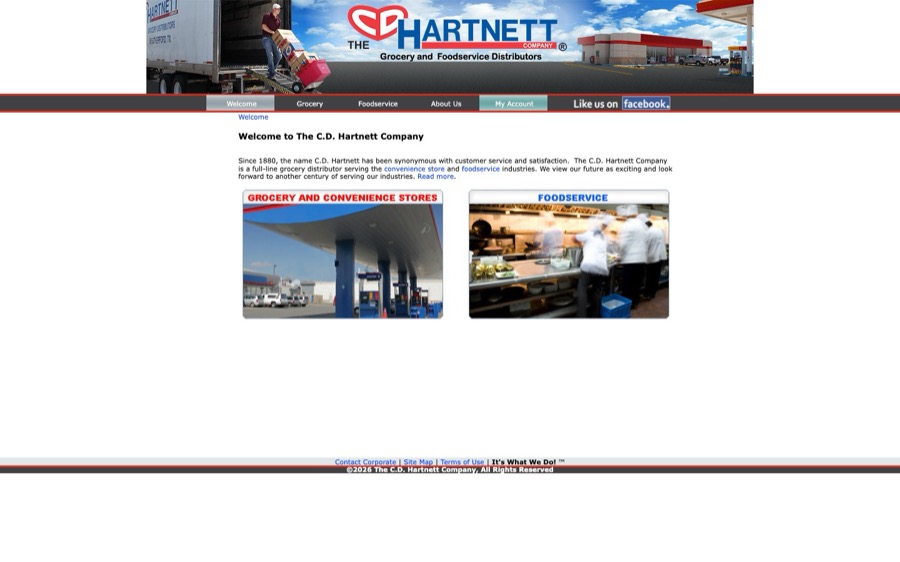
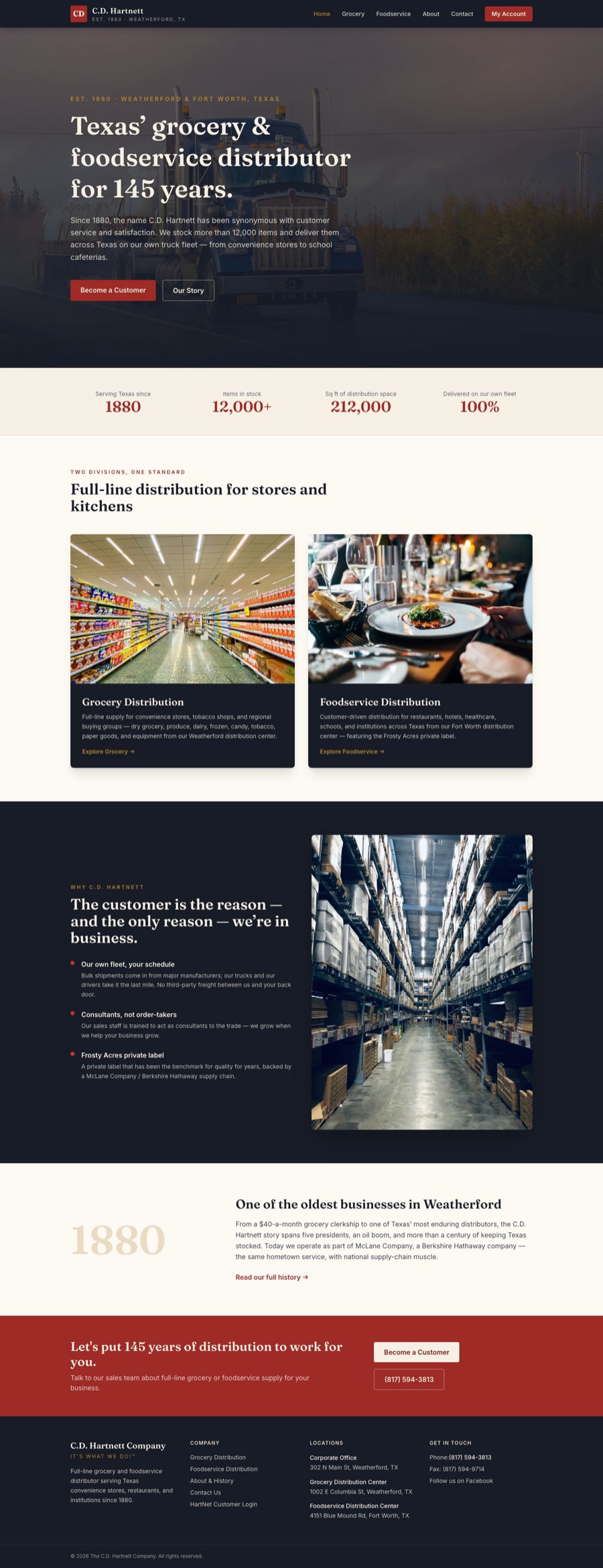
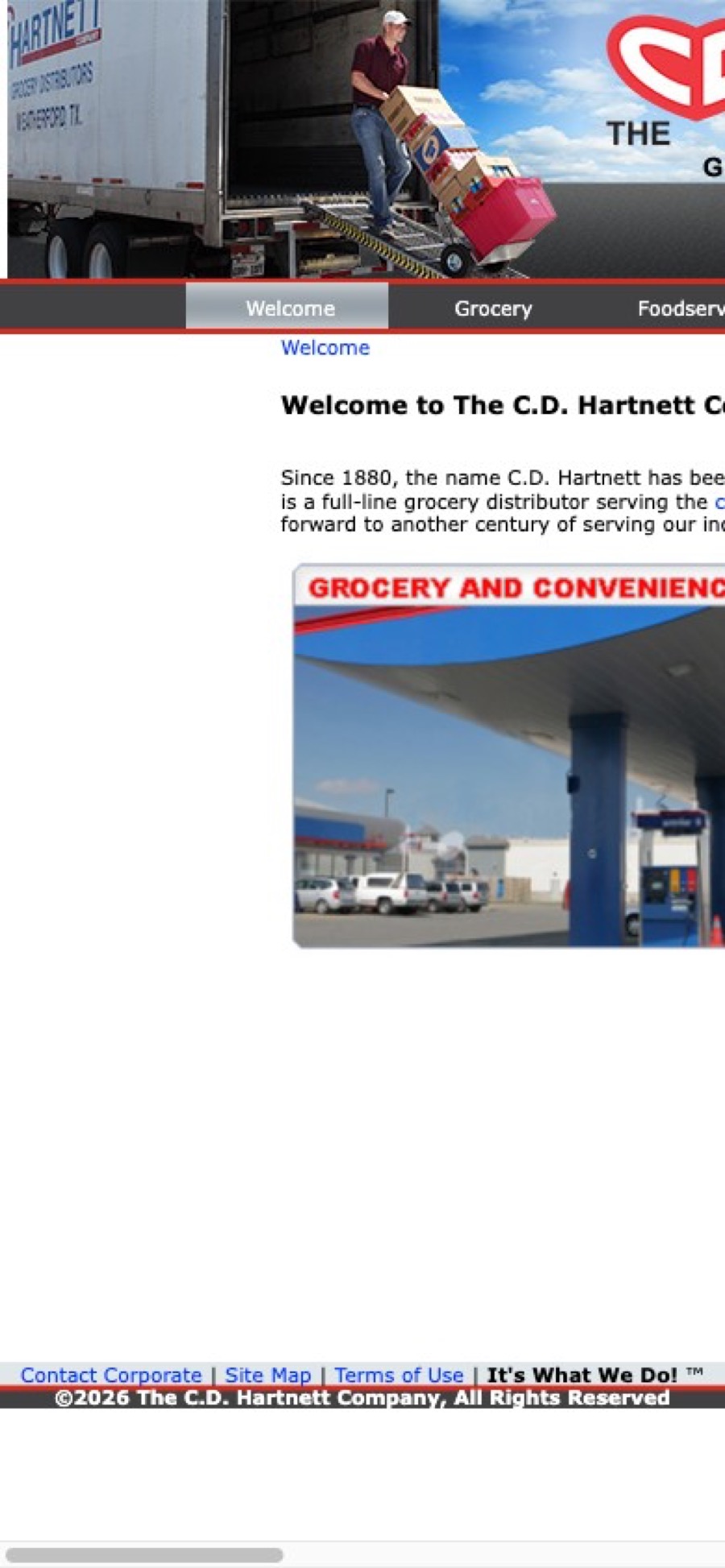
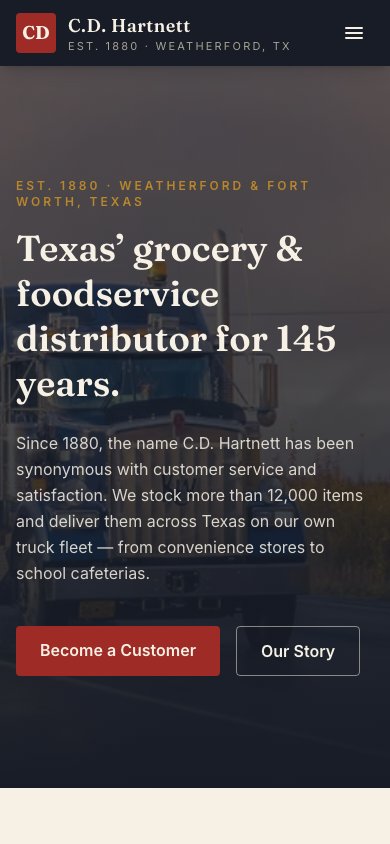
The Changes
What was fixed, and why it’s worth fixing
Swipe the table sideways to see each change →
| Change | Before | Why it’s a positive change |
|---|---|---|
| Responsive, mobile-first layout | Fixed 972px table grid; unusable on phones | Over half of business web traffic is mobile. A store owner checking a supplier from the truck cab can now actually read the site. Google also ranks mobile-friendliness directly. |
| Modern static architecture (Astro) | Java (.jsp) pages served from an aging application server | The public site becomes plain, pre-built HTML: loads in a fraction of the time, can’t be hacked through the CMS, and hosts for pennies. The HartNet customer portal stays exactly where it is — every login link is preserved. |
| Content & code cleaned up | 2012 seminar links, a hidden 2019 countdown and a dead analytics tag left in the source, table-based markup with no doctype | Old, cluttered code signals nobody’s home. The rebuild is clean, current HTML — no dead blocks buried in the page, no stale promos, nothing left to rot. |
| The heritage story, surfaced | The 1880 founding story hidden on a sub-sub-page | 145 years in business and Berkshire Hathaway ownership are the strongest trust signals the company owns. They’re now on the homepage and a dedicated timeline page — that’s what closes a skeptical new account. |
| Contact info everywhere | No phone number or address anywhere on the homepage | The phone number is now in the footer of every page, tap-to-call on mobile, with a department directory and map links. Fewer clicks between a prospect and a salesperson = more calls. |
| Real calls to action | No path for a new customer to start | “Become a Customer” and division-specific “Talk to Sales” buttons on every page turn the site from a brochure into a lead channel. |
| Accessibility & semantics | Layout tables, image-only navigation, no heading structure | Screen-reader and keyboard friendly, proper headings and landmarks. This is both an ADA risk reduction and exactly what search engines parse for ranking. |
| Performance | Unoptimized JPEGs, blocking scripts, mixed http/https content | Images are auto-converted to WebP at multiple sizes (hero image: 968 KB → 68 KB), fonts are self-hosted, and the only JavaScript on the site is the mobile menu button. Fast sites convert better and rank better. |
Search Engine Enhancements
Built to be found — by Google and by AI
The old site’s SEO was a 2009-era keyword list (including competitors’ names) that Google has ignored for over a decade. The rebuild uses what actually works in 2026:
- Unique title & meta description on every page — written to match what buyers search: “grocery distributor Texas,” “foodservice distribution Fort Worth.”
- Structured data (JSON-LD) — Organization, plus a WholesaleStore record for each distribution center with its real address, and a ContactPage record. This feeds Google’s knowledge panel, Maps, and the AI assistants customers increasingly ask for supplier recommendations.
- XML sitemap + robots.txt — generated automatically on every build and linked from every page, so new content gets indexed immediately.
- Canonical URLs & clean paths —
/grocery/instead ofesite.cd-hartnett.com/public/gr/gr-intro.jsp; consolidates ranking signals onto one domain instead of splitting them across subdomains. - Open Graph share cards — a branded 1200×630 image so the company looks intentional when a link is pasted into a text, email, or LinkedIn.
- Server-rendered HTML — all content is in the initial page source (no JavaScript required), which is what both search crawlers and AI answer engines read most reliably.
- Analytics-ready — the site is clean for a GA4 + Google Search Console setup on day one, replacing the dead Universal Analytics tag, so marketing decisions come from real data again.
Measured Results
The rebuild by the numbers
Investment
Three tiers — a full year of hosting included in every one
Same custom, mobile-ready rebuild at every level. What changes is how far it reaches: whether it’s tuned to be found on Google, and whether we keep it current for you after launch. You own the site and the code outright either way — no lock-in. A full breakdown is in the Pricing & Tiers document.
Tier 1 — Launch
- Six-page custom, responsive rebuild
- All content migrated and rewritten
- Secure hosting + SSL, DNS cleanup, bare-domain fix
- You own the site and the code
- The bare base — hosting billed separately at $300/yr
Tier 2 — Launch + SEO
- Everything in Tier 1
- Full SEO layer: structured data, sitemap, share cards, meta
- Analytics set up (GA4 + Search Console)
- Quarterly performance reports through year one
- Renews at $300/yr hosting
Tier 3 — Managed
- Everything in Tier 2
- Ongoing management — kept current, watched, reported on
- Monthly check-in, updates, and your own support portal
- A partner for future versions when you’re ready
- $9,500 build + $500/mo ($6,000/yr)
For scale: agencies quote this scope for a company of C.D. Hartnett’s size at $30,000+ to build, and most lock you into $1,500–$2,500/month retainers on top. Here the site starts at a flat $7,500, hosting is a simple $300/yr, and you walk away owning the site and the code. No lock-in — step up a tier only if and when it earns it.
Recommended Next Steps
Where this goes from here
1. Launch & DNS cleanup
Deploy to modern hosting, point cd-hartnett.com at it, and fix the invalid SSL certificate on the bare domain in the process. The HartNet portal keeps running unchanged on its current server.
2. Measurement
Optional add-on: GA4 + Google Search Console set up at launch, replacing the analytics that went dark in 2023, so you can watch traffic and rankings yourself. Quoted as a one-time setup whenever you want it.
3. Google Business Profiles
Claim and align profiles for all three locations with the site’s structured data — the single highest-leverage local search move for a distributor.
4. Real photography
Current imagery is professional stock. A half-day shoot — the fleet, the Weatherford warehouse, the team — makes every page unmistakably C.D. Hartnett.
5. Events & news, done right
A lightweight events page for food shows and seminars that’s easy to update — so the site never goes stale again.
6. Future iterations: ordering, in-house
Today, online ordering lives in outsourced software. As the new site earns its keep, phase two can bring it home: customer logins, live order guides and catalogs, order history, and internal sales reporting — built on this same foundation, so your customer and order data works for you instead of sitting in a vendor’s system. Scoped and quoted as its own project when you’re ready.
Why Ciera Grace Consulting
You work directly with the person who builds your site. There’s no account manager and no handoff — the same person who designs and writes it is the one who answers your email. You own the code outright, so nothing is ever locked to a vendor, and every price is set in writing before work begins, at a fraction of what an agency charges. The demo is live whenever you’d like to click through it, and I’d welcome a short call to walk your team through it.
— Ciera Muniz, Ciera Grace Consulting